


Anyone can experience early signs of psoriasis.This disease, according to experts, can have various causes and provoking factors for its occurrence - from severe stressful situations to nutritional disorders.Therefore, not everyone can immediately recognize and associate the pink spot that forms suddenly with scales on its surface with psoriasis in the early stages.You can't do it without expert help.Timely treatment and the implementation of all subsequent doctor's orders are the keys to a quick recovery.
Symptoms and pictures of early-stage psoriasis depend on the type
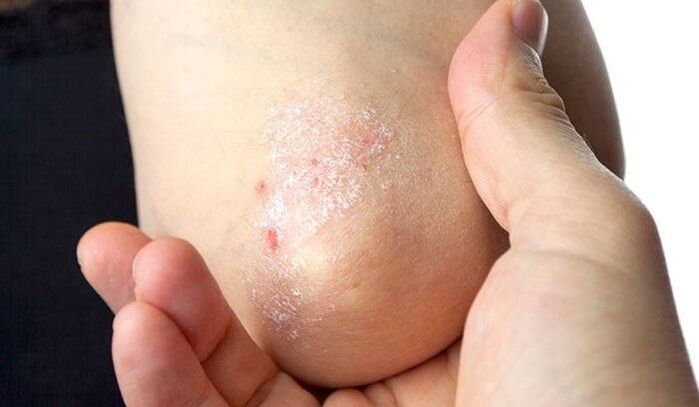
The manifestation of psoriasis at the stage of its appearance as an inflammatory process of the skin directly depends on the type of pathology and the background in which the disease develops.It is generally accepted to distinguish the following forms of pathology:
- ordinary;
- suppurating;
- point;
- teardrop-shaped;
- nails
Common locations of this disease are plantar-palmar, body, scalp, and elbows.Early psoriasis can be confused with dermatitis.However, the main elements - plaque - have some characteristics, according to which the doctor makes a diagnosis, for example, whitish scale.
With psoriasis, the epidermal layer of the skin becomes looser, flaky, and turns pink in color.The number of rash elements in psoriasis varies - from single to multiple, merging into a large defect.
The first symptoms of guttate psoriasis are often mistaken by people for allergies - food or medicine:
Spots in this case are small, pink and isolated.It forms in the places most exposed to friction from clothing.There is almost no peeling of the skin.
In the early stages, spot psoriasis can easily be mistaken for symptoms of other dermatological problems - from allergic urticaria to atypical rubella.
Only an experienced dermatologist can carry out an adequate differential diagnosis.Therefore, it is not recommended to delay consultation with a specialist.
Plaque psoriasis

The appearance of plaque-type psoriasis is one of the most common variants of the disease.Both of the stated symptoms may occur - multiple round red rashes, as well as barely visible elements.
The following changes will be observed on the surface of the skin:
- round elements with clear boundaries - Voronov rims;
- rash with psoriasis necessarily accompanied by peeling;
- for the first time elements, usually single ones, can disappear quickly;
- in the middle of the place, an almost invisible detachment of the epidermis appears - whitish scales.
Common sites of skin lesions are elbows and knees, head and face.In other parts of the body, plaque elements are diagnosed less often.
If you experience the above symptoms when psoriasis appears, it is recommended to see a dermatologist immediately.
When treating the early stages of psoriasis, you can quickly get rid of it.
A type of pustular disease
The most severe course is the pustular type of the disease.The early stages of psoriasis will be characterized by the rapid development of new areas of the skin.
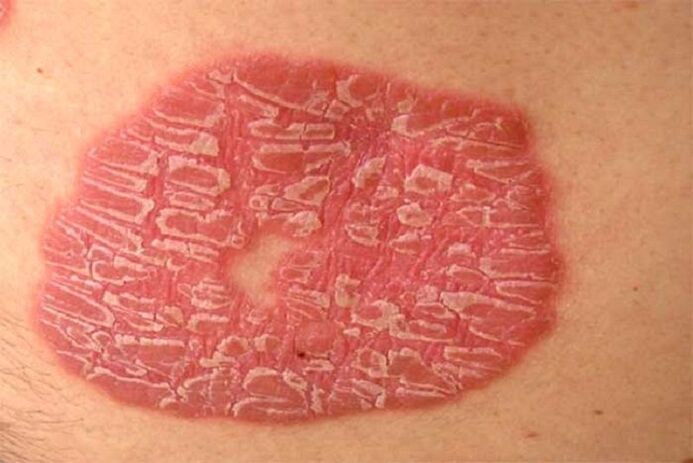
Generalized pustular psoriasis in the early stages can be quickly recognized from the photo:
The formation of papules occurs quickly, they are located in large areas of the body.May be accompanied by severe pain and fever.In the affected area, blisters with purulent contents are formed.
How does psoriasis manifest itself?:
- small bubbles appear on the background of the pink spot;
- the contents of the vesicles change from light to purulent;
- there are several other similar elements nearby;
- gradually they merge into one big bubble;
- after opening defects, erosions or ulcers that become crusted in this area.
If a single papule appears, for example, in the pubic area or armpit, then we may be talking about the local type of psoriasis with pustules.The appearance of the initial stage can be seen in the photo:
The wound is covered with a yellowish crust, which bleeds when removed.If a secondary infection occurs, the course of the disease becomes more complicated.Psoriasis treatment requires not only local therapy methods, but also the use of systemic drugs in a hospital setting.
Symptoms of spot psoriasis
The first signs of psoriasis in women with the point type of the disease are points of small diameter.In this case, there may be no peeling of the epidermis, or it may be less pronounced - almost none.
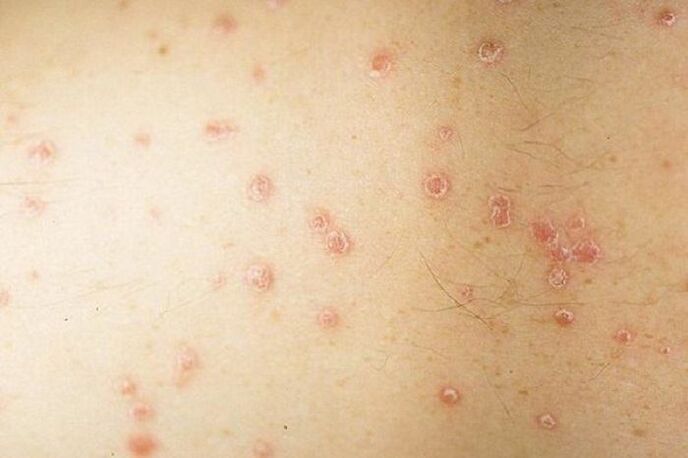
Common locations of elements are face, body, limbs.The rash is observed on other parts of the body that are most susceptible to friction from clothing, for example, the groin folds and armpits.
In the photo, early-stage psoriasis can be confused with other pathologies of the dermis:
The final diagnosis will be made by a dermatologist after laboratory and instrumental studies.Treatment at home is allowed, but under the strict supervision of a doctor: diet therapy, ointments and creams for external use, traditional medicine recipes.
Guttate Psoriasis
A viral infection spread by a person, which leads to a significant weakening of the immune system, can trigger the appearance of teardrop-shaped psoriasis.Many dermatologists adhere to this version.
Typical areas of localization of rash elements are the feet, palms, and even on the head, psoriasis which is often mistaken for a symptom of allergies.What psoriasis looks like in the early stages can be seen in the photo:
The rash initially has a pale pink color and is small in size.Then they begin to grow significantly, acquire a rich red color, and become covered with a crust.Sometimes the spots merge.
The most common question is: does psoriasis itch in the early stages?With this type of disease, the answer to the question is yes.The main complaint of the patient at the doctor's appointment is itching, and the nature of the rash will be shown later.Treatment tactics boil down to following a diet, taking antihistamines, and using medicated ointments.
Common localization sites in the early stages with photos
Common areas of the body where psoriatic elements are detected are the scalp, elbows, as well as knees and nails.In children, the disease can begin in the natural folds of the skin - inguinal, axillary.Therefore, elements of the rash are taken as symptoms of diaper dermatitis and allergies.And only the doctor after the examination can make the correct diagnosis.
However, in some cases, spots and plaques may be located atypically - for example, between the toes or on the nail plate, on the back of the neck, between the shoulder blades.In this case, the person does not pay attention to them and self-medication.The first signs of psoriasis in men and women progress to the next stage - a detailed clinical picture of the disease.In this case, special treatment is required.
What does psoriasis look like in the early stages?
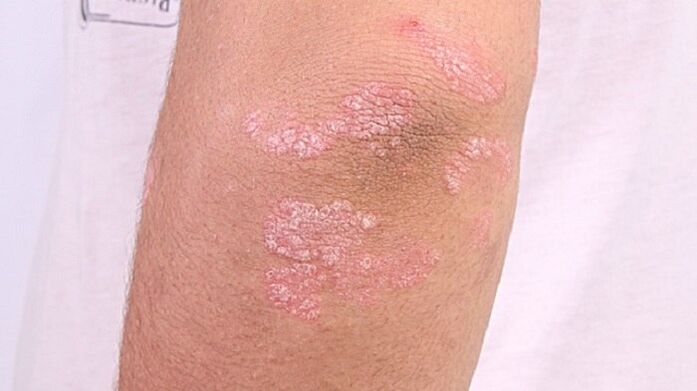
In most cases of psoriasis diagnosed on the body, the nature of the elements is largely determined by the type of pathology.Plaque variant defects are localized in areas of skin friction.
The early stages of psoriasis are shown in the photo:
Symptoms of body psoriasis are as follows:
- the appearance of round spots, shade - from pink to flesh-colored;
- medium height of the defect above the surrounding skin;
- the size of spots varies - from dotted to large, confluent type;
- flaking - from a single scale to numerous crusts of different colors;
- there may be cracks and erosion on the surface of the element;
- itching - from barely noticeable to intense, interfering with work and rest;
- rarely – fever, in severe cases of this disease.
Depending on the stage, the treatment will be prescribed by the doctor - from external agents, for example, ointments, decoctions and lotions, to tablets with anti-inflammatory, antibacterial, hormonal effects.
How does psoriasis start on the scalp?
Initially, scalp lesions appear as small areas of flaking, usually along the hairline.It is often mistaken for superficial dandruff, so effective measures - specific treatment - may be delayed.
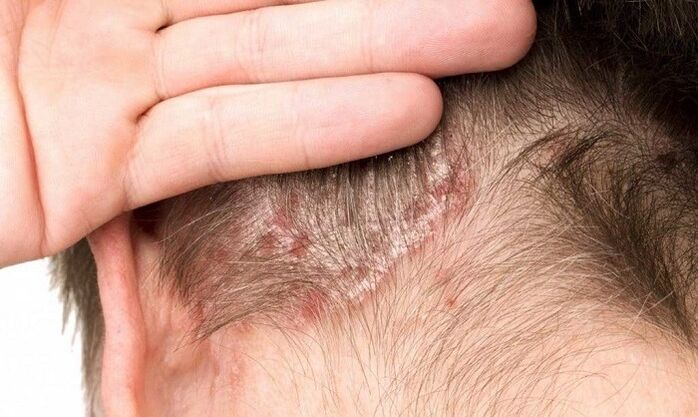
Over time, intense peeling, itching, as well as papules and pustules with serous content appear, in places that form crusts after opening.The skin becomes inflamed, thickened, and painful.Hair, however, does not fall out, because the lesion affects the upper layer of the epidermis, without involving the hair follicle in the process.
At first, treatment is symptomatic - following a diet, using anti-inflammatory shampoos and ointments.If bacterial or fungal microflora has joined, the doctor will prescribe the appropriate medicine.
Early nail damage
Nail damage with psoriasis resembles a fungal infection - longitudinal stripes on the nail plate, dots along the edges, increased fragility.The root itself may not be involved in the pathological process.
As the pathology develops, the nail plate thickens and loses transparency.The process of longitudinal striation and delamination of the nail is observed.In severe cases, it completely peels off from the underlying tissue.
Modern laboratory research methods help to recognize diseases in time and carry out differential diagnosis.Treatment of toenails and nails - special ointments, tea tree oil, lotions with medicinal decoctions - must be carried out under the supervision of a doctor.If you seek medical help early, you can quickly get rid of this disease.
The first appearance of psoriasis on the palms and soles
Peeling of the skin of the palmar and plantar areas of the body is not immediately distinguished as psoriasis.At first, people mistake these symptoms for allergic dermatitis or fungus.
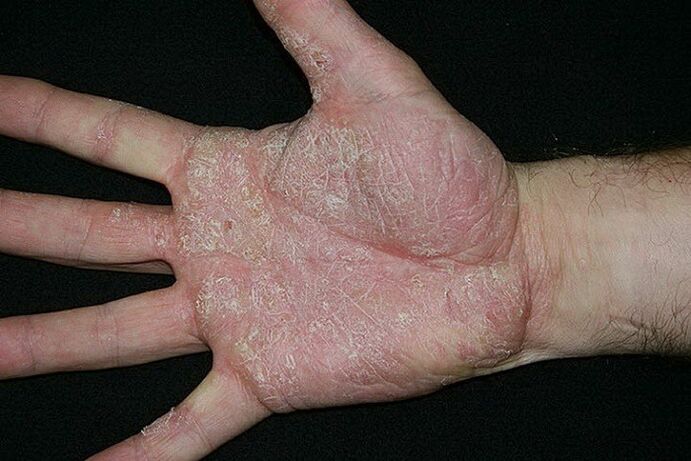
However, as the pathology develops, characteristic signs are added - plaque spots, psoriatic scales and crusts, itching.The rash quickly spreads all over the legs, up to the knees and up.From the palms of the hands spots can spread to the body or face.
Remission seems to be a decrease in the main symptoms, but the dark color of the epidermis may persist, but without itching or peeling.Symptoms of psoriasis on the hands last longer due to the fact that this area of the body experiences more aggressive external factors.
Therapeutic tactics are based on the same principles: strict dietary therapy, abandoning bad habits, using healing creams, lotions, and ointments.Success in the fight against psoriasis lies in following all the doctor's recommendations.
The development of psoriasis at an early age
Small children are also at risk for this disease, including infants and newborns.This is due to the fact that the tendency to the disease can be inherited, and in certain circumstances, for example - improper care, artificial nutrition, symptoms of the disease will make themselves felt.

You can check with your pediatrician about how psoriasis develops in children at an early age.You should pay attention to slight changes in skin color - normal spots and peeling will not always be noticed.The first rash is often detected in the folds - groin, axillary area.
What to do at the early signs of psoriasis in young children should be decided by a doctor.As a rule, measures are taken to eliminate provoking factors, strengthen children's personal hygiene, and proper nutrition.
First aid in the early stages of psoriasis
When faced with the first clinical manifestations of this disease, it is important not to be confused, but to consult a doctor and start treatment.It is important to monitor yourself carefully:
- adhere to an alkaline diet for psoriasis - food should alkalize the internal environment, for example, vegetable salad, puree soup;
- completely eliminate the use of alcoholic beverages, because alcohol has an adverse effect on psoriasis;
- carefully monitor personal hygiene - take a warm bath, wear underwear made of natural fabrics, lubricate the affected skin with emollient creams and oils;
- walk more in the fresh air - ultraviolet rays have a good effect on the condition of the skin;
- avoid stressful situations - nervous overload and psycho-emotional shock worsen the course of the disease;
- use special ointments and creams on the affected area, as well as take medicines prescribed by your doctor;
- In order for the remission to last longer after the exacerbation is relieved, it is recommended to visit a special resort or, if possible, relax in the Dead Sea for 3-4 weeks a year.